

Leadership in a Constantly Reactive World
There is reactive leadership and there is reflective leadership.
In today’s world, leaders are under constant pressure and forced into rapid decision-making. There is always an email, a meeting, a new notification. Rather than letting you choose what kind of leader you want to be, these constant stimuli force leaders to be reactive.
We are not saying that reactive leadership is bad. There is a time and place. However, what we are saying is that many leaders spend their days reacting rather than thinking, and this creates an imbalance. Reflective leadership is forgotten.
We are here to remind you: the best leaders are not necessarily the busiest. They are often the ones who create space to think, reflect, and gain perspective.
What Is Reflective Leadership?
According to Harvard Business School, reflective leadership involves self-awareness, introspection, and continuous learning and growth to make better decisions, enhance leadership skills, and improve team performance.
Reflective leadership is about learning from experience instead of simply moving from one task to the next.
The Reflective Leadership Model
One example of a reflective leadership model comes from Harvard Business School Professor Nien-hê Hsieh. His framework is built around four interconnected components: awareness, judgment, action, and reflection.
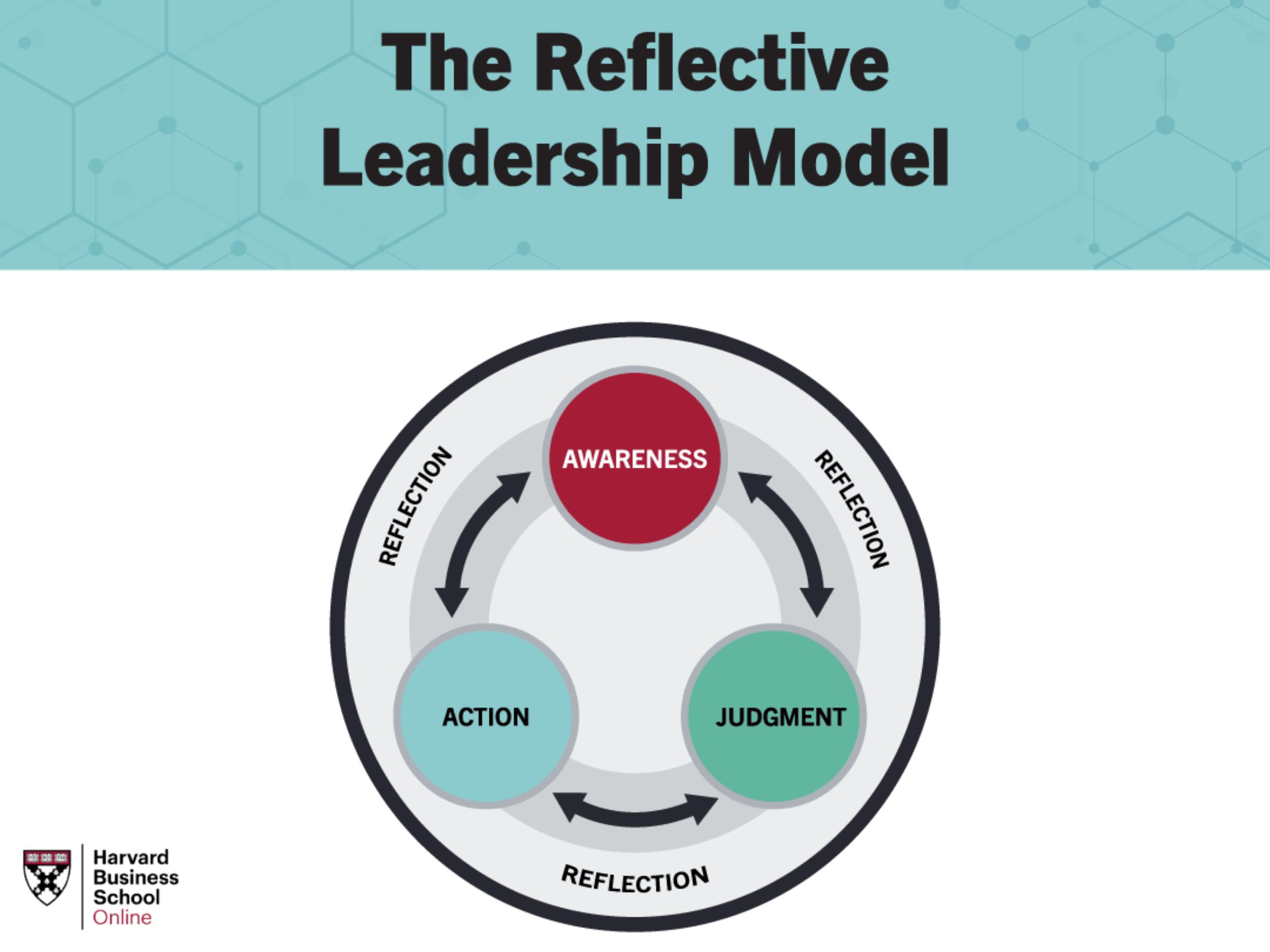
Awareness involves understanding your responsibilities as a leader. Judgment means examining the biases and assumptions that influence decisions. Action is following through in a way that is accountable and aligned with your values. Lastly, reflection ties everything together by helping leaders learn from experience and improve over time.
This model provides a valuable structure for decision-making, however, it approaches reflection from a business and organizational perspective.
A more mindful interpretation of reflective leadership is one that expands beyond decisions and outcomes to include self-awareness, presence, and personal growth.
From this perspective, reflective leadership can be viewed as a simple but powerful cycle: Pause, Process, Proceed.
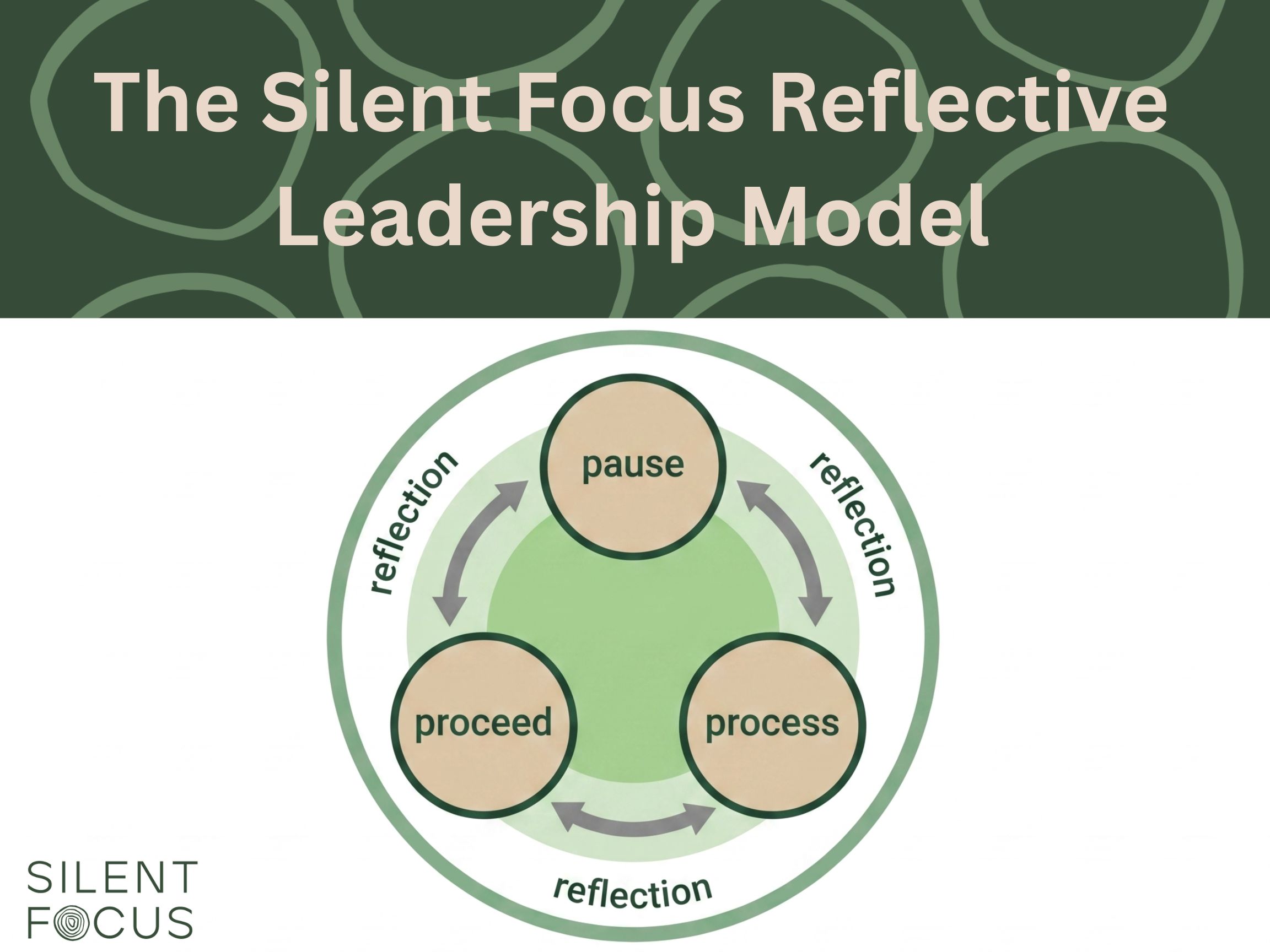
Rather than reacting immediately to challenges, reflective leaders first pause. They create space to step back from the pressure of the moment and observe the situation more clearly. They then process what is happening, considering not only facts and outcomes, but also emotions, assumptions, values, and the perspectives of others. Only then do they proceed, taking action with greater clarity and intention.
This approach recognizes that leadership is not only about making better decisions. It is also about cultivating the awareness and presence needed to make those decisions wisely.
Why Reflection Has Become a Leadership Skill
The modern workplace rewards speed
As we mentioned before, the modern workplace rewards speed. Work environments are more fast-paced, which means that decisions need to be made quickly. However, things are moving so quickly that many leaders are experiencing information overload. When there is constant pressure to provide immediate answers, there is often less space for reflection, making it harder to make thoughtful, well-considered decisions.
The Benefits of Reflective Leadership
This is why reflective leadership is so important. The practice has several benefits such as:
- Better Decision Making: The most sought-after benefit. Through reflection in leadership, one can evaluate outcomes, identify blind spots, and learn from mistakes.
- Greater Self-Awareness: Reflective leaders have the power to understand their own strengths, weaknesses, triggers, and leadership habits.
- Improved Emotional Intelligence: Reflection, in general, improves empathy, communication, and listening, which at the end of the day benefits your team, and makes you a stronger leader.
- Reduced Burnout: In such a fast paced environment, burnout is more common than ever (especially in men). Reflective leadership encourages taking pauses, having a positive perspective, and developing healthier leadership habits.
- Stronger Team Engagement: Leaders who understand their own impact are better equipped to build trust, communicate effectively, and foster a healthy, relationship-based organizational culture.
How to Improve your Reflection Skills
Like any leadership skill, reflection can be developed through intentional practice and a willingness to slow down and think more deeply.
1. Reflective leadership begins with self-awareness
Before leaders can reflect on their decisions, they must first understand their own commitments, values, and guiding principles. This creates a baseline for evaluating decisions and helps bring greater clarity to the thoughts, assumptions, and emotions that shape their actions.
Professor Hsieh recommends asking yourself the following questions:
- What’s core to my identity?
- What lines or boundaries won’t I cross?
- What kind of life do I want to live?
- What kind of leader do I want to be?
2. Keep a Leadership Journal
Spend 5 to 10 minutes at the end of the day jotting down what went well and what could be handled differently.
You can answer the following:
- What went well today?
- What challenged me?
- What did I learn?
3. Seek Feedback
Actively asking colleagues and teams for constructive input on how your leadership style is being perceived is a great way to also expand your self-awareness.
4. Practice Silence
Reflective leadership is interconnected with silent leadership, which right now is another huge competitive advantage.
At the core it really means:
- Listening more than you speak
- Pausing before responding
- Leading through actions, not instructions
- Asking thoughtful questions instead of giving answers
- Staying calm under pressure
- Creating space for others to contribute
If you want to learn more about silent leadership, make sure to read this article on it!
Reflection, Silence, and Leadership
Reflection requires something that many leaders struggle to find: space. Silence creates the space that reflection needs. Yet, in our world, it is hard to find a space that is not noisy.
By stepping away from distractions, leaders can process experiences more clearly, evaluate decisions, and consider the bigger picture. This is often where strategic thinking emerges, not in the middle of constant activity, but in moments of stillness.
This is one reason why practices such as mindful leadership, digital detoxes, and silent corporate retreats have gained popularity among executives and business leaders.
At Silent Focus we have a popular corporate retreat that blends leadership skills with silence. Monika Varela and Heather Anderson bring you through several leadership workshops where you share, explore and dissect your leadership skills by practicing roll playing on conflict situations. Using the reflective leadership approach and emotional intelligence for leaders, you also practice empathetic listening and non-violent communication. The leadership workshops are before and after the 24hrs of silence at the retreat where you will practice meditation and breathwork in silence and you will reflect on how when you are more mindful after silence your leadership style changes. If you’re interested in creating more space for reflection and strategic thinking, learn more about our corporate retreats. For more information about our leadership retreats visit the corporate retreat page.
Many leaders discover that their clearest thinking happens not when they are doing more, but when they finally have the space to think. Reflection helps them step back from immediate pressures, see the bigger picture, and reconnect with their values, priorities, and long-term vision.
In this sense, silence is not the absence of productivity. It is often the environment where the most important insights emerge.
The Leaders Who Pause Often See Further
In conclusion, leadership is not only taking action externally, but having awareness internally. It is clear that reflection is becoming a competitive advantage.
It might be hard at first. We have gotten very used to always moving forward and feeling pressured into taking the next step quickly. However, reflective leadership is not about slowing progress. It is about creating enough space to ensure that progress is taking a step in the right direction.
Sometimes the most powerful step a leader can take is not forward, but inward.
Follow us on Instagram to learn more about silence and corporate retreats @silentfocus.co, and if you like this style of content join our newsletter.