
Why Most Goal Setting Fails
Let’s get straight to the point: the problem with goal setting isn’t a lack of ambition, it’s a lack of space to think clearly. Most leaders set goals during busy workdays, and annual planning often happens between meetings, emails, and deadlines. This is why many executives use retreats and offsites for strategic goal setting.
When distractions are removed, leaders can step back from day-to-day demands and focus on where they want to go next. One surprisingly effective tool for this process, used during offsite retreats but also that you can try at home, is the vision board.
What Is a Vision Board?
A vision board is a physical or digital collage of images, quotes, drawings, symbols, and affirmations that represent your goals, priorities, aspirations, and desired lifestyle. Acting as a daily reminder of your intentions, it helps keep you motivated and focused on the actions needed to achieve your ambitions.
Many times people believe that vision boards are purely personal, and more of an arts and crafts “hobby”. Although this is true, they can also be professional, for example:
- Business vision boards: A visual representation of a company’s or entrepreneur’s long-term goals, brand identity, and core values. It serves as a strategic roadmap, combining images, charts, and text to keep abstract objectives tangible and top-of-mind.
- Leadership vision boards: A leadership vision board is a visual collage that represents a desired future state for a team, department, or individual. It acts as a strategic tool to bridge big-picture goals with tangible actions, serving as a daily reminder of what to focus on.
These are just two broad concepts of what your professional vision board could focus on, but it is entirely up to you. Just keep this in mind: A vision board is not about predicting the future. It is about creating clarity around the future you want to build.
Why Leaders Are Rethinking Goal Setting
In today’s world, leaders are under constant pressure and information overload, which forces them into rapid decision-making, or in other words, reactive leadership. These are the things that inhibit effective goal making and follow-through.
As we have talked about in our article Why Reflective Leadership Is Becoming an Essential Skill, reflective leadership involves self-awareness, introspection, and continuous learning and growth.
What does this mean for vision boards? Well, effective goal setting requires reflective leadership, and not reactive leadership. Leaders need time away from daily demands, because strategic and reflective thinking happens when there is space.
The Psychology of Goal Setting
Let’s get into how and why goal-setting works.
Goal-setting theory
One of the most influential frameworks in the psychology of goal setting is Goal-Setting Theory, developed by psychologists Edwin Locke and Gary Latham. The theory suggests that people perform better when they set goals that are specific, challenging, and meaningful, rather than vague intentions such as simply “doing their best.”
Clear goals provide direction, increase motivation, encourage persistence, and help people focus their energy on what matters most. Research also shows that commitment and regular feedback play an important role in turning goals into results.
Visualization
Visualization is the mental practice of vividly imagining a desired goal in sensory detail. This means closing your eyes and engaging your emotions and imagination in order to rehearse your steps towards success. That’s right! You literally have to imagine yourself fulfilling your goal. This way, your brain essentially treats the imagined scenario as a lived experience, priming your neural pathways for actual achievement.
Attention and focus
What we repeatedly see influences what we notice and pay attention to. This is one reason vision boards can be such a useful goal-setting tool. By keeping long-term goals visible, they act as a constant reminder of what matters most, helping to direct attention toward goal-relevant actions rather than everyday distractions.
These three elements are also key as to why vision boards work: you set specific goals, you visualize them, and the board helps you maintain your attention and energy on them!
Do Vision Boards Work?
Of course vision boards work! However you need to remember that they are a tool at your disposal, and they won’t do all the work for you.
Vision boards do NOT:
- guarantee success
- magically attract outcomes
- replace action
However, what vision boards CAN do is:
- Help you set goals
- Increase clarity
- Strengthen your motivation
- Improve your focus
- Encourage intentional decision-making
A vision board works best when it is paired with consistent action, which can only come from you.
Why Retreats Are Ideal for Goal Setting
As mentioned before, you can always make a vision board at home, but making one during a corporate silent retreat could be all the more beneficial.
It is difficult to envision the future when your attention is consumed by the present.
In a setting such as a silent retreat, you are slowly immersed in an experience that alters your mental and physical state. You become more relaxed, and at the same time more focused. More importantly, you are intentionally focused, which means no distractions, deeper reflection and a clearer perception.
This is the optimal time to make goals. At a retreat, leaders can truly think long term, reassess priorities, identify what truly matters and set meaningful goals.
Creating a Vision Board on a Retreat
Now that we’ve explored the theory behind goal setting, let’s look at how to put it into practice.
Step 1: Reflect Before Creating
Ask yourself these questions. If you have a mindfulness journal or a stillness planner, use it as an opportunity to write these down and really take your time:
- What matters most right now?
- What do I want more of?
- What do I want less of?
- What kind of leader do I want to become?
Step 2: Gather Visual Inspiration
This is the fun part, get creative! You can use:
- magazines
- photographs
- words
- symbols
- drawings
If you want, you can even incorporate some more sensory items like string, flowers or leaves.
It is also important to mention that physical vision boards often encourage greater presence and creativity than digital versions.
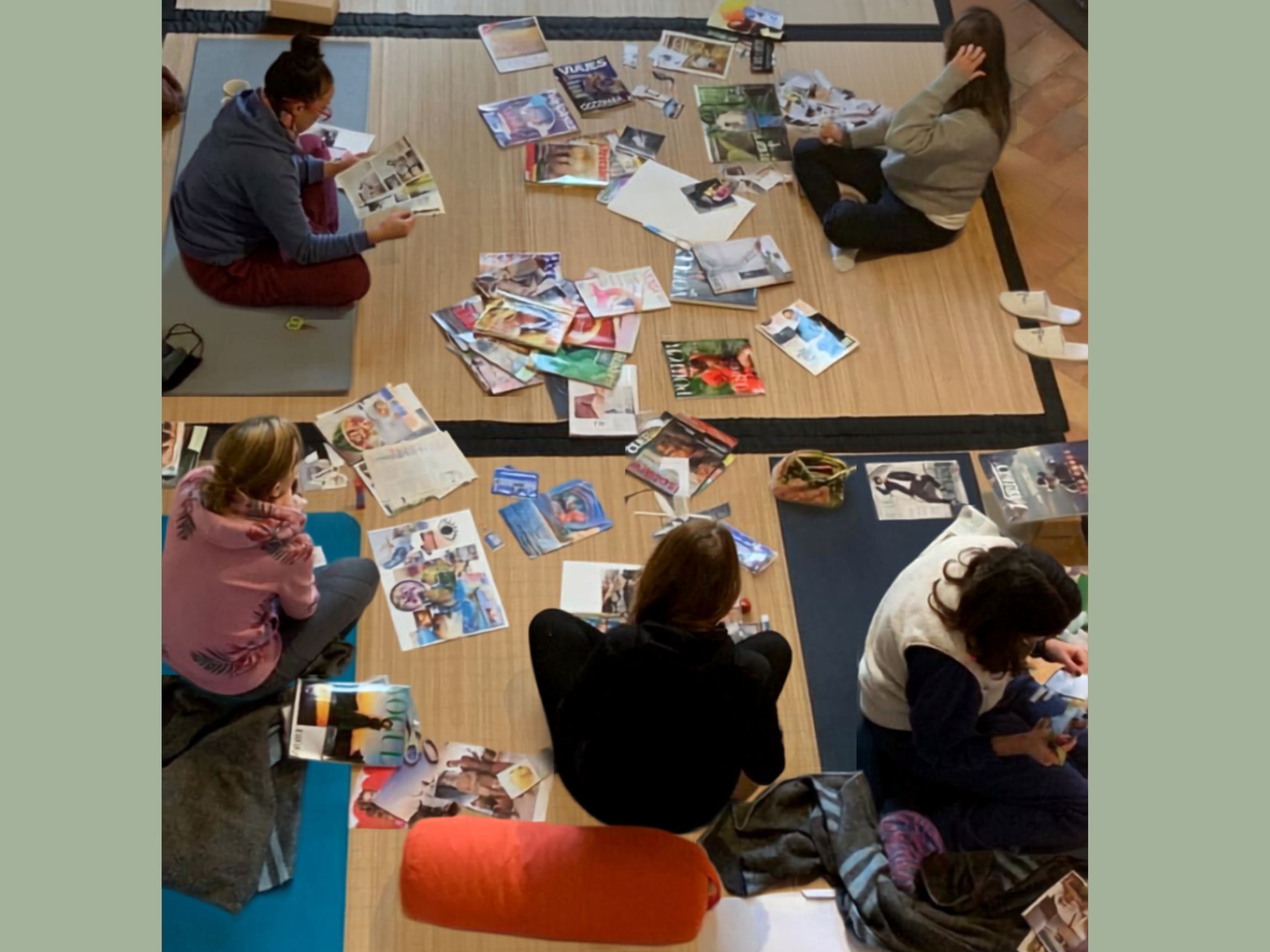
Heather, the owner of Silent Focus, makes a vision board every couple of years. She finds the best way to do it is sit with tons of magazines and just go through them and pick out anything that resonates with you. Keep your mind blank and just go through the magazines and cut out anything that interests you or is part of your theme. After having several magazine cutouts then you start organizing the images into your future on paper. Many print outs get left out, some things get written down while other images still need to be found. This process can take several hours if not days.
Recently this year Heather spent one day cutting out images at home and then several months later after a silent retreat came home and made her future vision board. (There actually is still something missing that needs to be placed in the centre, a picture of Heather with eagle wings that she found on a hike with friends). Heather found that after being at the silent retreat she was able to shape her vision on paper but before that time she did not see it clearly and had no motivation to finish her vision board.
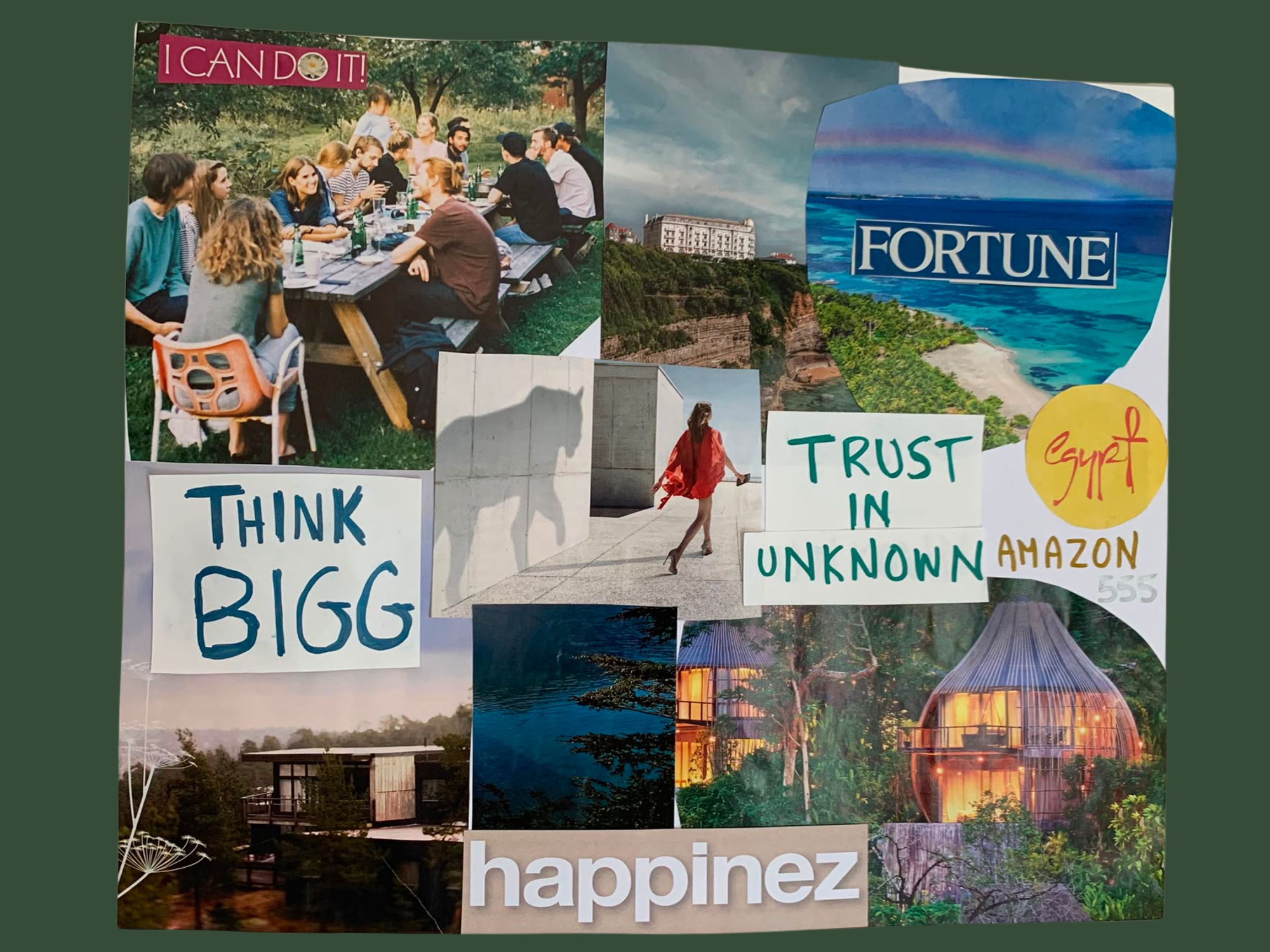
Silent retreats are necessary when you create vision boards as they help you focus and cut away everything that doesn’t matter so you are able to zoom in on what does.
Step 3: Organize Around Themes
Try to organize your vision board in sections, or ideas. For example, revolving around:
- career
- leadership
- wellbeing
- relationships
- purpose
- creativity
Step 4: Revisit Regularly
This is the most important step. Vision boards are living documents, and regularly reviewing and adjusting goals can strengthen commitment, provide a sense of accomplishment, and promote continuous personal growth.
Heather, for example, puts her new vision board beside her bed on the wall so she can see it every day when she wakes up and every night before she goes to sleep. It is a constant reminder of the future she wants to create for herself.
Vision Boards as a Leadership Tool
As we mentioned, some organizations incorporate vision boards into leadership retreats, goal-setting workshops, and strategic planning sessions.
Rather than focusing solely on individual aspirations, a leadership vision board may explore themes such as company culture, team values, long-term objectives, innovation, or organizational purpose.
Creating a vision board collaboratively is also a great idea. It can encourage meaningful discussion about where a team wants to go and how it intends to get there. This way, the entire team is consciously working towards the same objectives.
The process can also strengthen communication and strategic thinking. By stepping away from day-to-day responsibilities and reflecting on the bigger picture, leaders often gain greater clarity about the direction they want their teams and organizations to take.
Ultimately, a leadership vision board is not just about setting goals. It is about creating a shared vision that helps guide decision-making, reinforce values, and keep long-term priorities in focus.
Better Goals Begin with Better Reflection
Goal setting is not just about productivity it is about direction. In a world that constantly encourages leaders to react, reflectiveness is key. Creating space for reflection allows leaders to step back from daily demands, reconnect with their priorities, and think more strategically about the future.
Whether on a retreat or at home, this space can help transform vague intentions into meaningful goals. Tools such as vision boards provide a way to keep those priorities visible and guide future decision-making.
Before leaders can decide what they want to achieve, they first need the space to ask a simpler question: What truly matters?
Follow us on Instagram to learn more about corporate retreats and silence @silentfocus.co, and if you like this style of content join our newsletter.