People have been creating mandalas for thousands of years across different cultures and spiritual traditions. Today, mandalas are used not only for spiritual practice, but also for creativity, mindfulness, meditation, and self-reflection.
What Is a Mandala?
The term mandala comes from Sanskrit, the word is deeply rooted in two terms that translate directly to “essence container”. Manda meaning “essence”, and la meaning “container” or “vessel”. However, it is also true that it can be interpreted as meaning “circle” or “sacred center”.
Visually mandalas are a complex, geometric pattern or configuration of symbols organized around a central point, representing the universe, wholeness, balance, interconnectedness, and the cyclical nature of life.
While mandalas are often associated with spirituality, their origins stretch back thousands of years.
The History and Origins of Mandalas
Mandalas trace their origins back to Buddhist culture in India as early as the 1st century B.C.E, and practices and were first found in a Hindu text, called Rig Veda.
Buddhist monks traveling along the ancient trade routes carried mandalas with them, introducing the art to regions like Tibet, China, and Japan by the 4th century. Because of this, mandalas soon became present in Hinduism, used in rituals and sacred art.
Not only that, but throughout history, similar circular patterns appear in Celtic art, indigenous traditions, Christian rose windows and other ancient architecture.
Mandala Symbolism: What Do the Shapes and Patterns Mean?
There are three main types of mandalas: teaching mandalas, healing mandalas, and sand mandalas.
Teaching mandalas are full of symbolism, with each shape, colour, and pattern representing a different idea or teaching. Students create their own mandalas based on these principles, using the design to visually express what they have learned. In this sense, a teaching mandala acts as a map of knowledge, bringing different concepts together into a single image.
Some characteristics of mandalas and their meanings:
- The Circle: Represents unity, completion, and wholeness
- The Center Point: Is the source of awareness and inner self
- Symmetry: Represents balance and harmony
- Colours: Colors have different meanings as well, for example, blue means calm, green means growth, yellow is energy, red is vitality, and white is clarity.
However, it is important to remember that while traditional symbolism exists, personal meaning is often just as important.
Sand Mandalas
Sand mandalas have been created for centuries by Tibetan Buddhist monks Navajo cultures, and are used as part of spiritual and religious practices.
These intricate designs are made from coloured sand, by gently tapping the side of a funnel or bottle to let the sand flow in a precise, continuous stream. There is also the method of using a traditional chak-pur, where you run a metal rod along the ridged side to create a vibration that controls the flow of the sand.
These designs often take days or even weeks to complete. Once finished, they are carefully dismantled to symbolize the impermanence of life and the importance of letting go.
Watch Tibetan Monks Create a Sand Mandala.
Creating a sand mandala requires extraordinary patience, concentration, and mindfulness. Watching the process offers a glimpse into the meditative nature of this ancient practice.
Mandala Meditation and Mindfulness
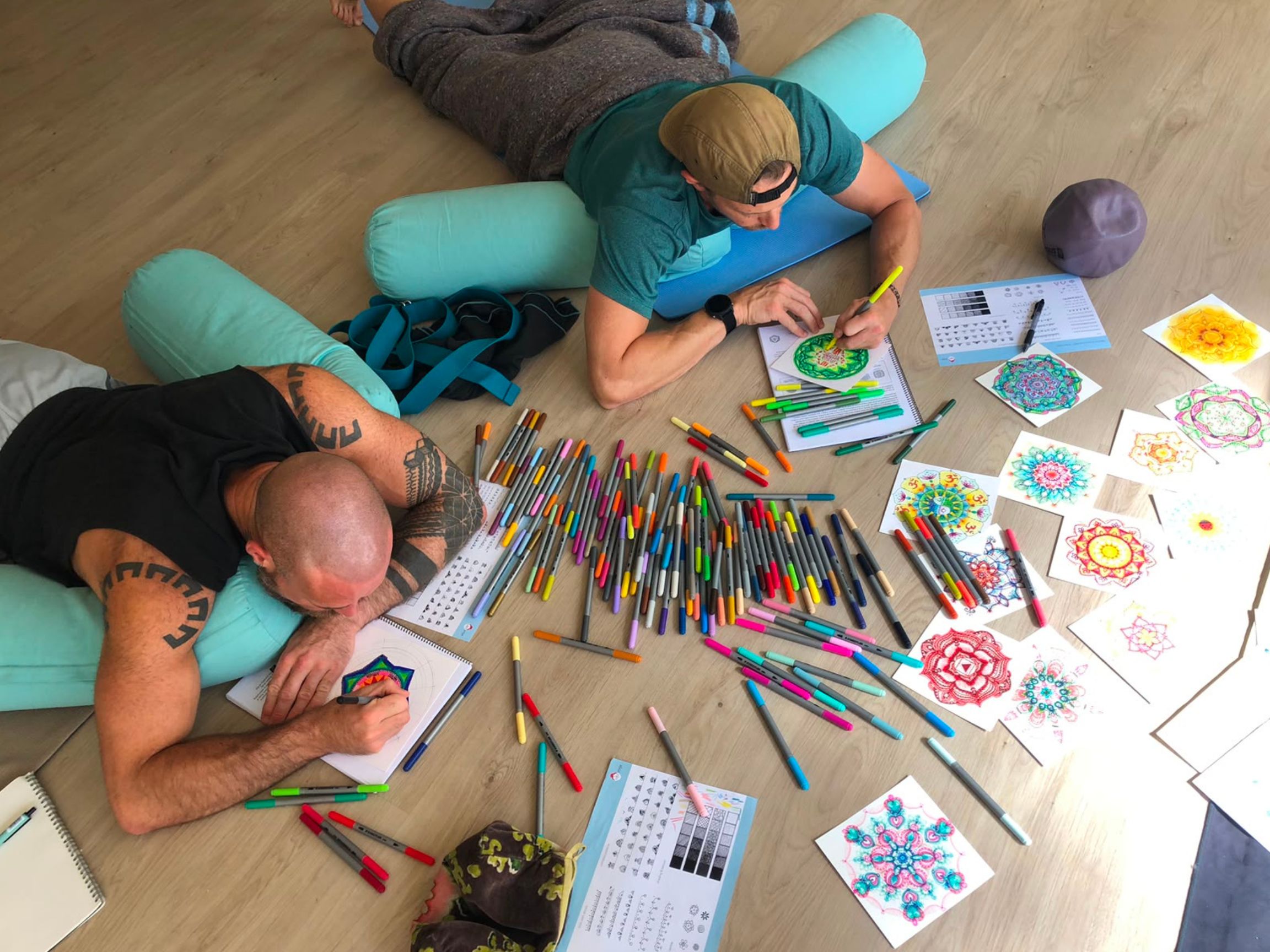
Healing mandalas are created with meditation and self-reflection in mind. Unlike teaching mandalas, they are often more intuitive and personal. The process of creating or observing them can encourage focus, promote a sense of calm, and support emotional wellbeing.
Creating or observing a mandala helps:
- Focus attention: Requires sustained attention.
- Quiet mental chatter
- Support emotional expression: Colours and symbols can communicate feelings.
- Encourage present-moment awareness: People often lose track of time while creating.
- Reduce stress: The repetitive patterns can feel soothing.
- Create a sense of calm
The repetitive, circular nature of mandala creation encourages the mind to slow down and settle into the present moment.
Collaborative Mandalas: A Mindful Group Practice
While mandalas are often created individually, they can also be a powerful group activity. At Silent Focus corporate retreats, participants sometimes create collaborative “Nature Mandalas” using natural materials such as flower petals, leaves, stones, and sticks. Each person contributes to the design, allowing a shared piece of art to emerge organically.
Unlike many group activities, creating a mandala does not require constant discussion or planning. Participants work together through observation, creativity, and presence. The process encourages cooperation, patience, and mindfulness while fostering a sense of connection with both nature and the people around them.
At silent retreats, mandala creation often becomes a powerful form of non-verbal expression, allowing participants to communicate through creativity rather than conversation. The focus shifts away from words and towards shared intention, creating a sense of community without the need to speak.
How to Draw a Mandala
Here is a simple beginners guide to drawing a mandala:
- Draw a circle.
- Mark a center point.
- Create repeating sections, as if your circle was a pizza and you’re cutting it into slices.
- Add patterns and shapes. While traditional spiritual mandalas from Hinduism and Buddhism lean heavily symmetry to represent balance and the cosmos, modern and personal mandala art is highly adaptable, so be creative!
- Colour mindfully.
And remember: the goal is not perfection. The process itself is the practice.
More Than Art
Mandalas have been used for centuries as tools for meditation, reflection, and spiritual practice. Today, mandalas continue to offer value beyond their spiritual origins.
Whether created with pen and paper, coloured sand, flower petals, or natural materials found outdoors, and whether created alone, in nature, or as part of a group retreat, the process encourages mindfulness, creativity, and focused attention, providing a simple yet meaningful way to reconnect with ourselves and our surroundings.
Rather than concentrating on the finished result, the practice invites us to slow down and become fully engaged in the present moment.
In a world full of distractions, creating a mandala offers something increasingly rare the opportunity to be fully present with a single, simple act of creation.
Follow us on Instagram to learn more about silence and meditation @silentfocus.co, and if you like this style of content join our newsletter.