
Why Office Noise Is Back on the Agenda
According to a recent report highlighted by FMJ, Facilities Management Journal, a UK publication focused on workplace design, facilities management, employee experience, and office environments, office noise remains a significant deterrent for employees returning to the workplace.
Open-plan offices were designed to encourage collaboration, but many employees report the opposite experience: more distractions, reduced focus, and increased stress.
Therefore, the question is no longer whether office noise is a problem. The question is how organizations can address it.
The Problem with Noise in the Modern Workplace
Office noise, conversations, phone calls, meetings, even keyboard sounds and office equipment, compete for attention in employee’s minds. The brain constantly filters environmental stimuli, but sometimes the distractions become too many.
Cognitive switching is the involuntary shifting of your brain’s attention away from your main task and toward an unexpected or changing sound. Your brain does this automatically as an evolutionary survival tool to scan for danger, but it disrupts your focus in a modern environment.
This is why office noise is more than a simple annoyance. It is an environmental factor that can directly influence how people think, feel, and perform at work.
How Office Noise Affects Employees
Office noise has a negative effect on employees, causing mental fatigue and stress as the brain has to spend energy trying to filter out all the disrupting sounds. This leads to:
Reduced Focus and Productivity
It is astonishing, really. Workers exposed to a single nearby conversation can be up to 66% less productive.
Multitasking is a very common word that people love to throw around. However, the human brain cannot do two things at the exact same time, so what it does is jump back and forth between both. The real name for multitasking is actually task switching. Clearly, changing tasks takes time and energy. This means a reduction in focus as well as productivity.
Increased Stress and Fatigue
In our article about the difference between rest and distraction we talk about the Attention Restoration Theory, or ART. The theory states that there are two modes of attention: directed attention, which requires deliberate focus on tasks such as studying or working, and undirected attention, where the mind is not purposefully focusing but naturally lets its attention wander.
Throughout the day, employees use directed attention to concentrate, make decisions, solve problems, and ignore distractions.
In noisy office environments, the ability to maintain directed attention takes more of a toll. Even when people are not actively listening to conversations or background sounds, the brain continues working to filter them out, which leads to mental fatigue.
Additionally, noise is a significant stressor. Research shows that regular exposure to noise can increase stress levels and place additional strain on the body. Even everyday sounds such as phone calls, notifications, and background chatter can affect heart rate and contribute to feelings of fatigue and stress over the course of a working day.

Office Noise Solutions: What Actually Works?
Acoustic Panels and Sound Absorption
Acoustic panels and sound absorption systems in offices reduce echo, lower ambient noise levels, and improve speech clarity. These tools are effective in open office layouts, where noise levels tend to be higher. What these panels do is soak up sound waves, creating a calmer and more productive work environment.
Sound Masking Systems
While sound absorption systems take away sound, sound masking systems add soft background noise to cover up external noises.
For example, speakers can be installed directly inside open drywall or drop-ceiling tiles, pointing straight down into the room. They project sound directly to the listeners below. This provides uniform coverage and is excellent for environments with lower ceilings or no ceiling tile grids.
Although this system might be a bit hard to get used to, it is always an option.
ANC or Active Noise Cancelling
Providing employees with noise-cancelling headphones can be an immediate and effective solution for reducing or mitigating noise. These devices help block out background noise, allowing employees to concentrate better on their tasks.
Although these are great for individual use, it may be uncomfortable to wear for too long.
Office Layout Changes
Offices are now implementing various open office noise solutions that are perfectly adapted to the modern employee.
First are quiet zones, kind of like a library, work areas where it is not permitted to talk, listening to music has to be contained to your headphones and not too loud, and silence is the goal.
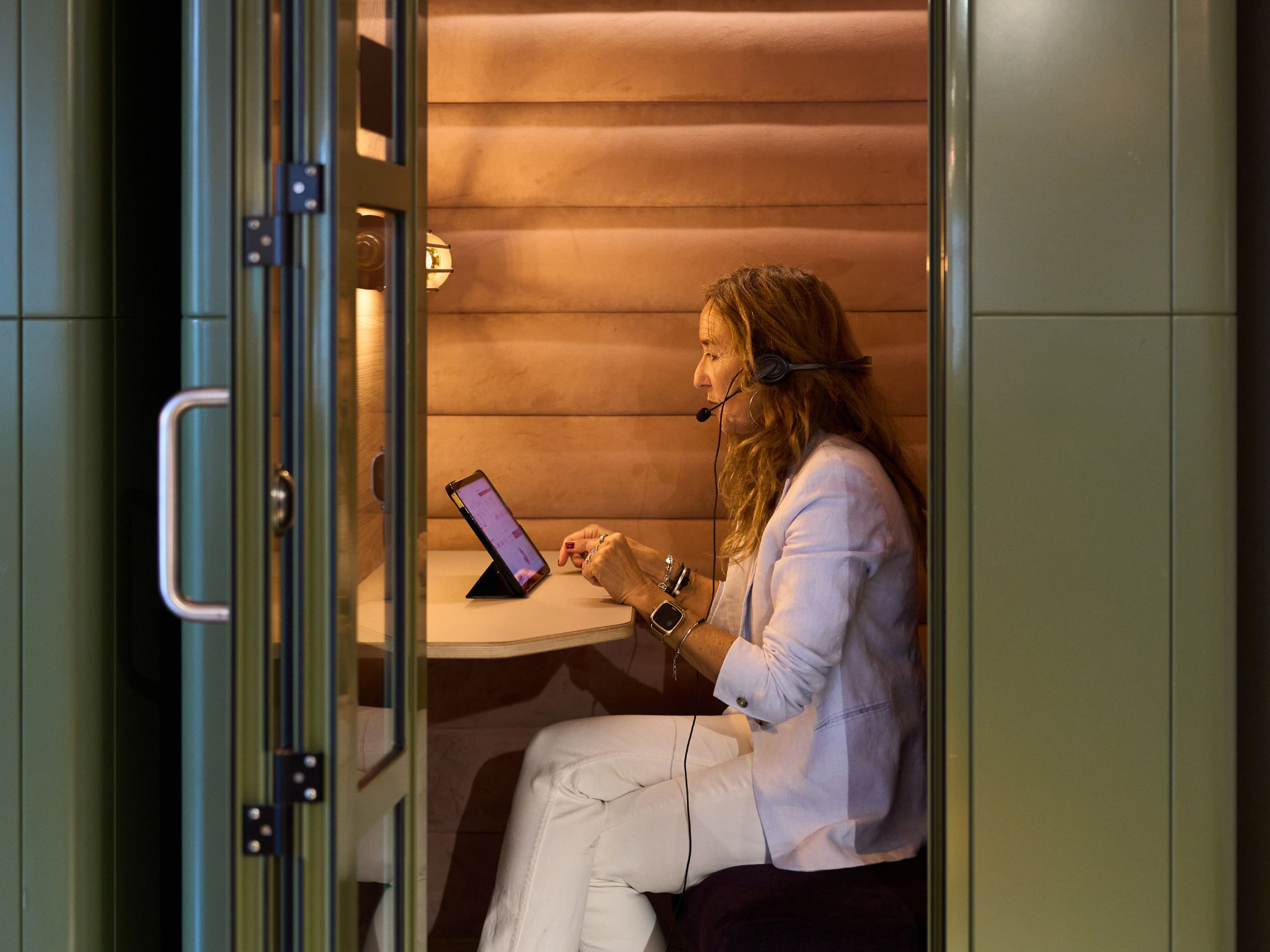
Phone booths and meeting pods are also becoming more common in offices today, although the concept itself isn’t new. These soundproof spaces come in two forms: phone booths, which are smaller and designed for individual use, and meeting pods, which are larger and built to accommodate small groups. Both are engineered to block out external noise, giving employees a quiet, focused environment for solo work or confidential conversations.
A tech company called Venus Aerospace installed soundproof pods in their noisy hangar. The booths are in constant use, and the implementation of them into the office culture has been so successful that the president has taken a booth for his own private office, with him stating, “this is maybe the most important thing we’ve done in terms of being able to get work done.”
Of course, this is a more extreme example, given that a hangar is much louder than a regular office, but it just goes to show that no matter what your work environment is, it is important to take measures to reduce distracting noise.
Noise Surveys
If you want to implement any of these options, remember that a good first step is always hearing first-hand experience and opinions from your employees.
Ask your employees how they feel about the noise level in the office in order to identify problem areas.
Sometimes the loudest areas aren’t where management expects.
The Limitation of Acoustic Fixes
Reducing office noise is a positive step. A quieter environment can improve concentration, lower distractions, and make the workplace more comfortable for employees.
However, even in a low-noise office, people may still struggle with stress, mental fatigue, and a lack of focus.
This is because workplace wellbeing is influenced by more than the physical environment alone. Many employees arrive at work already carrying the effects of information overload, burnout, decision fatigue, and constant stimulation.
In other words, acoustic solutions improve the environment, but they do not necessarily address the underlying fatigue many employees are experiencing.
Silent Retreats: A Different Kind of Solution
This is where retreats offer something different.
Retreats are not a replacement for good office design or acoustic improvements. They complement them. While office noise solutions focus on the workplace itself, retreats create an opportunity for recovery through conscious disconnection.
Through silence, reflection, and time away from everyday demands, employees can step out of reactive mode, reduce information overload, regain focus, and reconnect with the bigger picture.
As we have explored in our articles on the science of silence, reflective leadership, and the difference between rest and distraction, sometimes what people need is not simply a quieter office, but the opportunity to truly reset.
Fix the Office, But Don’t Forget the People
Acoustic improvements that reduce office noise matter now more than ever. Open offices should be defined thoughtfully, not only to create a collaborative space, but also to allow employees the calm environment needed to be focused and productive.
Still, it is important to remember that reducing noise in the office only addresses one part of the issue. While quieter workplaces can improve concentration and wellbeing, they do not necessarily help people recover from the effects of constant stimulation, distraction, and information overload.
Sometimes what employees need is not simply a quieter environment, but the opportunity to experience genuine silence. A chance to step away from the demands of everyday life, reset mentally, and return with greater clarity.
Follow us on Instagram to learn more about corporate wellbeing and silence @silentfocus.co, and if you like this style of content join our newsletter.