
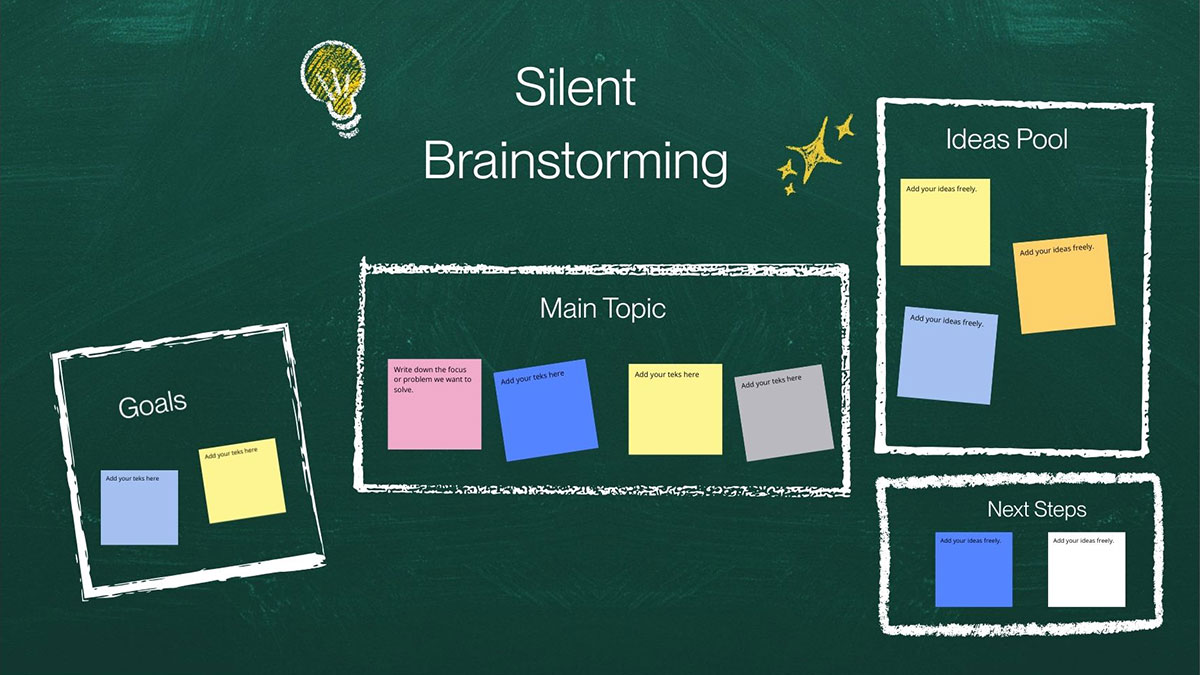
Silent brainstorming is a structured creativity technique where participants generate ideas individually and privately, without speaking, before sharing them with the group. Instead of loud, free-for-all discussions where one voice can dominate, silent brainstorming emphasizes quiet, focused idea generation followed by organized collection, categorization, and evaluation. The method can take many forms sticky-note sessions, digital idea boards, shared documents, or timed writing exercises but the core principle remains the same: silence first, conversation later.
Step by step explanation about what is silent brainstorming
- Problem framing: The facilitator presents a clear prompt or question. Example: “How could we reduce customer onboarding time from 10 days to 3 days?”
- Individual ideation (silent): Participants take a fixed amount of time to write down their ideas privately. They don’t speak, debate, or judge just produce.
- Collection: Ideas are collected. In an in-person workshop this could mean sticking notes on a wall or dropping index cards into a box. In remote settings this might be a shared online board (e.g. Miro) or a document.
- Clustering and synthesis: The facilitator groups similar ideas, looks for patterns, and synthesizes combined concepts.
- Discussion and refinement: Only now does the group discuss, refine, prioritize, and develop the most promising ideas into action items or prototypes.
- Next steps: Assign owners, deadlines, and metrics for follow-up.
By incorporating silent brainstorming into your corporate culture, you can empower all employees to contribute meaningfully, fostering a culture of inclusion, creativity, and collaboration.
History of brainstorming
The idea of separating ideation from evaluation goes back several decades. Brainstorming as a formal technique was popularized by Alex Osborn in the 1940s with his rules (defer judgment, encourage wild ideas, quantity over quality, combine and improve ideas). Over time, researchers identified problems with Osborn-style group brainstorming especially production blocking (waiting your turn), evaluation apprehension (fear of judgment), and social loafing (relying on others). Silent brainstorming sometimes called brainwriting, 6-3-5 method, or written brainstorming emerged as a response to those issues.
- 6-3-5 brainwriting: A classic variant where 6 participants write 3 ideas in 5 minutes, then pass their sheets on and build on each other’s notes. It formalizes silent, iterative written ideation.
- Nominal Group Technique (NGT): A structured method from the social sciences where individuals silently generate ideas, then share them in a round-robin, and finally rank them. NGT is used in research and strategic planning.
- Modern remote adaptations: With the rise of digital collaboration tools, silent brainstorming evolved into asynchronous idea collection on digital boards and documents useful across time zones.
Why silent brainstorming is a good idea
- Reduces dominance and groupthink: In loud brainstorming, extroverted or senior participants often steer conversation. Silence levels the playing field so ideas from quieter or junior members surface.
- Prevents anchoring: When early suggestions are voiced, subsequent contributions get anchored to them. Generating ideas in private reduces conformity and increases variety.
- Increases idea quantity and diversity: People think differently when they’re not interrupted. Silent time often yields more, and more original, ideas.
- Encourages deeper thinking: Silence gives space for reflection. Participants can build more thoughtful, nuanced ideas than when pressured to speak immediately.
- Faster in some contexts: For a well-facilitated session, silence + collection + clustering can produce many more ideas in less time than an unstructured discussion.
- Inclusive: People who process information differently (introverts, neurodivergent individuals, non-native speakers) often prefer writing time to verbal rapid-fire.
- Documented output: Since ideas are written down from the start, you have an immediate record to analyze, prioritize, and follow up on.
If you lead workshops or run a creative team, try a silent session next time and pair it with a clear follow-up process. You’ll likely end up with more ideas, stronger participation, and most importantly better experiments that move your work forward.
Risks and limitations
Silent brainstorming isn’t a silver bullet. Be mindful of these drawbacks:
- Lack of spontaneity and cross-pollination: Immediate conversation can spark hybrids of ideas. If you silence discussion too long, you may miss creative synergies born from quick back-and-forth.
- Poor facilitation can flatten results: If the prompt is unclear or collection is chaotic, silent ideation can produce a pile of unworkable notes.
- Potential for superficiality: Some people need prompts or conversation to dive deep; given only silence and an ambiguous prompt, they may offer surface-level ideas.
- Excludes those who rely on talking to think: For some, verbalizing is how they form ideas. You can combine silent and vocal methods to accommodate different thinking styles.
- Over-reliance on written clarity: Not everyone is equally comfortable expressing ideas in writing; that might bias results toward stronger writers.
- If not followed by action, it fosters cynicism: Generating ideas in silence only to archive them without follow-through will erode trust.
How to run an effective silent brainstorming session
- Craft a focused prompt. Narrow prompts outperform vague prompts. Instead of “How can we grow?”, try “How can we increase our free-trial-to-paid conversion by 20% in six months?”
- Set a timebox. Typical quiet ideation windows are 5–20 minutes depending on complexity.
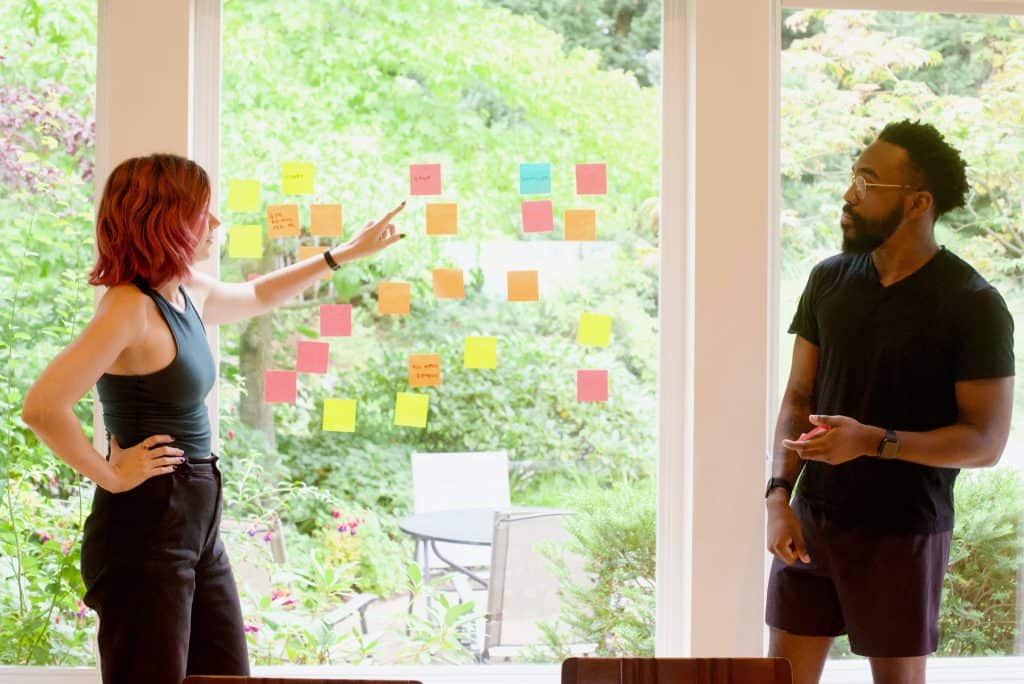
- Give clear instructions for format. For example: “Write one idea per sticky note; include a title and one-sentence explanation.”
- Choose the right tool. In-person: sticky notes, index cards. Remote: digital whiteboards, shared spreadsheets, or forms.
- Encourage wild ideas. Emphasize quantity and discourage self-editing in this phase.
- Collect and cluster quickly. Use affinity mapping to find patterns; involve participants in grouping if time permits.
- Prioritize transparently. Use dot-voting, impact/effort matrices, or simple ranking to pick winners.
- Assign owners and timelines. Convert ideas into small experiments with clear next steps.
- Mix it up. If a group consistently uses only one format, rotate methods to keep cognitive energy high.
Here are some great examples of effective silent brainstorming sessions
- Product feature ideation: Each team member silently writes 3–8 feature ideas for the next release. Notes are posted, grouped by theme (usability, performance, integrations), then discussed.
- Customer experience improvements: During a customer success offsite, everyone silently writes pain points from recent support tickets and possible fixes. The team clusters and selects the top three to prototype next quarter.
- Marketing campaign concepts: Marketers individually draft subject lines, taglines, and visuals. The group later combines the best pieces into A/B testable campaigns.
- Remote asynchronous ideation: A manager posts a prompt in a shared doc. Team members add their ideas within 48 hours, without immediate commenting, to avoid anchoring to early suggestions.
- Silent brainwriting in classrooms: Students silently write responses to a complex question; their answers are later pooled, giving quieter students equal voice.
Silent brainstorming is a deceptively simple tool that tackles some of the biggest problems in group ideation: dominance, conformity, and production blocking. It’s especially powerful in mixed teams (junior + senior, introverts + extroverts) and in remote or asynchronous contexts. But it’s not an either/or choice, the best facilitators blend silent ideation with catalytic conversation so teams get the benefits of both deep reflection and collaborative synthesis.
During a silent retreat, the Silent Focus Team will work with the team leader to confirm and set an appropriate prompt to frame the problem for the silent brainstorming session. This will be explained during the group meeting before the introduction and the transition into silence. There may be more than one silent brainstorming session proposed during a silent retreat, depending on the length of the corporate retreat. All ideas will be collected and synthesized into groups and discussed during the final meeting after the silent portion of the retreat.
Because participants spend an extended period in silence, ideas can sometimes be more profound and detailed compared to those generated in a standard silent brainstorming session. Silent brainstorming works particularly well during a silent retreat when there is a complex problem that needs to be solved and previous approaches have not been successful. When teams spend over 24 hours in silence and engage in meditation, creative ideas tend to flow naturally. Having a focused challenge to reflect on during silence often leads to fascinating results.
If you are ready to try a silent retreat with a focus on silent brainstorming, please contact the Silent Focus Team for more information.